Architecture Guide
This document describes the structural invariants the confii-go codebase relies on. It is intended for contributors and reviewers; if you are looking to use the library, start with the README and the documentation home.
The invariants below are not "rules of style." They are load-bearing properties that other parts of the codebase depend on for correctness. Violating one is more likely to surface as a hard-to-reproduce production bug than as a CI failure.
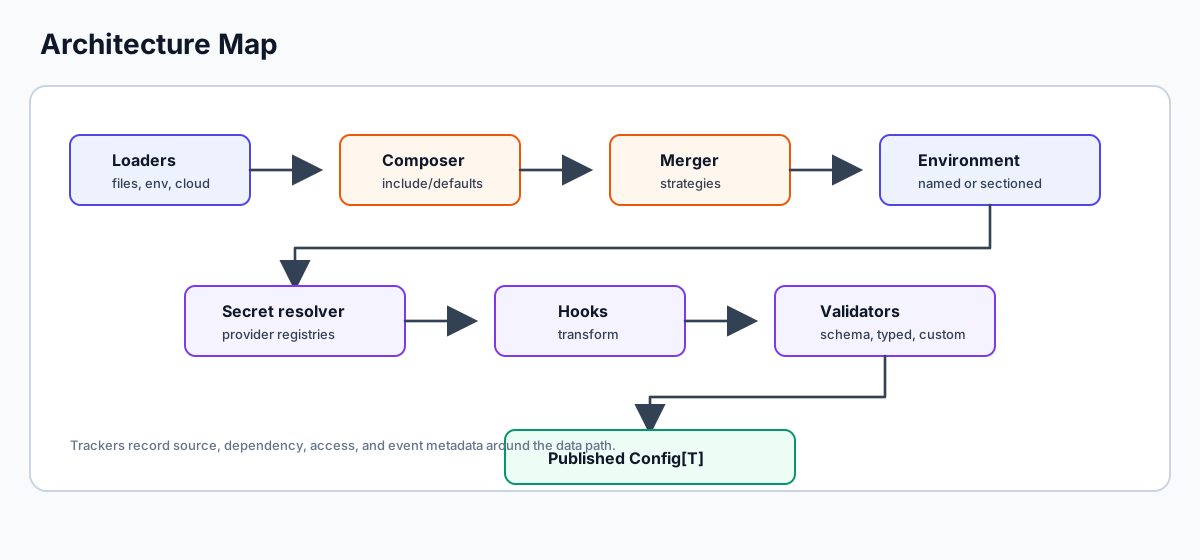
Table of Contents
- Root Package Layout
- The DeepCopy Engine
- The Override Stack
- Self-Config Provider Registries
- Cross-Cutting Invariants
0. Root Package Layout
The module root is the public github.com/confiify/confii-go/v2 package. Go
packages are directory-based, so the public facade and its package tests stay
at the repository root. Files are divided by responsibility; moving a public
type into a subdirectory would create a different import path and is therefore
an API change.
| File | Responsibility |
|---|---|
config.go |
Config[T], construction, and core state invariants |
config_load.go |
loader execution and layer-cache rebuilding |
config_access.go |
getters, typed access, defensive read snapshots |
config_mutation.go |
Set, runtime mutation, and change callbacks |
config_inspect.go |
source inspection, documentation, and export |
config_reload.go |
full/incremental reload candidate preparation and validation gates |
config_extend.go |
runtime loader-extension candidate preparation |
config_source_transaction.go |
shared Reload/Extend capture, publication, retry, and lifecycle signals |
config_override.go |
composable override stack and restoration |
config_lifecycle.go |
freezing, environment identity, and file watching |
config_observe.go |
metrics, events, drift, and version management |
config_hooks.go |
hook traversal and hook-facing accessors |
config_self.go |
self-configuration application |
config_validation.go |
JSON Schema and typed validation orchestration |
config_file_loader.go |
self-config-discovered local file parsing |
config_copy.go |
snapshot copies shared by transactional operations |
New behavior belongs in the narrowest existing responsibility file. Do not
create generic util, misc, or helpers files; a helper should live with
the behavior that owns it unless several transaction paths genuinely share it.
Public key-path operations
Package: configmap
The dependency-free configmap package owns Confii's dot-separated map path
contract. Its Get, Set, Has, and Keys functions are available to
custom loaders, validators, exporters, and independently versioned Confii
modules. Set is atomic on error and returns typed categories for invalid
paths, nil maps, and scalar/map conflicts. Keys is deterministic and returns
fully qualified paths that can be passed back to the other operations.
Core code may retain narrow internal wrappers where that keeps unrelated
dictionary behavior cohesive, but it must not reimplement path parsing or
mutation. Optional cloud modules import configmap rather than maintaining a
provider-local path implementation.
Root tests follow the same rule. Public contract tests use package
confii_test by default. Tests use package confii only when they must inspect
private state or exercise an internal failure path. Test names and comments
describe the behavior and contract being verified without relying on internal
audit identifiers. Cross-package end-to-end tests belong under integration/;
there is no generic top-level tests/ package.
1. The DeepCopy Engine
Package: internal/dictutil
Internal API: DeepCopy,
DeepCopyValue
Why a reflection engine
The library's Config[T] accepts arbitrary user values through
Set, Override, and the loader pipeline, and returns values
through Get, Typed, Export, and the source tracker. Both
boundaries must isolate caller-owned state from internal state — a
caller mutating a slice it passed to Set must not corrupt
envConfig, and a caller mutating a slice it received from Get
must not corrupt the read-side cache.
A typed switch over the shapes a JSON / YAML decoder produces
(map[string]any, []any) is insufficient. Real callers pass
[]byte, []string, map[string]int, custom structs, pointers
into shared graphs, and occasionally cyclic structures. A handler
that misses any of these silently aliases caller state into Config
state.
The reflection engine handles every Go value uniformly. There is exactly one place in the codebase that decides "how do I clone an arbitrary value?" and every isolation boundary delegates to it.
The reflect.Kind strategy
deepCopyRV switches on reflect.Kind:
| Kind | Strategy |
|---|---|
Bool, all int/uint/float/complex, String |
passthrough — primitives are immutable |
Chan, Func, UnsafePointer |
passthrough — no reachable Go-level state to clone |
Pointer |
allocate via reflect.New(elem.Type()); recurse into Elem(); visited-set detects cycles |
Slice, Array |
element-by-element; primitive-element fast path uses a single reflect.Copy |
Map |
MakeMapWithSize; recurse keys and values; visited-set detects cycles |
Interface |
recurse into the concrete inner value, repackage into the original interface type |
Struct |
bit-copy first; overwrite settable exported fields with deep clones; time.Time is a special case |
The struct bit-copy-then-overwrite tradeoff
Go's reflect package cannot Set an unexported field —
Value.CanSet() returns false. A naive "deep-copy every field"
strategy would either:
- Skip unexported fields, leaving them zero-valued in the clone.
This silently corrupts any struct whose state lives behind
unexported fields (
sync.Mutex, custom buffered types). - Use
unsafeto write through the field offset. Fragile across Go versions and likely to trip the race detector.
The bit-copy-then-overwrite approach gets the best of both:
unexported fields are preserved verbatim (so a sync.Mutex carrying
its lock state survives the clone), and every settable exported
field is then overwritten with a deep clone. Unexported reference
fields remain shallow — the engine cannot do better without unsafe
access — but the public surface a caller can mutate through the
struct's API is fully isolated.
The time.Time carve-out
time.Time has three unexported fields: wall uint64, ext int64,
loc *Location. The first two are immutable values; the third is a
pointer to globally-shared, immutable state in the time package. A
plain bit-copy is both safe and necessary — reflect.Value.Set
cannot reach the unexported loc field, so descending into struct
field iteration would fail. The engine recognizes time.Time
explicitly and returns a bit-copy clone.
This is the only type-specific carve-out in the engine. Every other struct type goes through the generic bit-copy + overwrite path.
Cycle detection
A user-supplied value graph can be self-referential:
The engine carries a visited map[visitedKey]reflect.Value keyed by
(reflect.Type, allocation address) for every reference-typed
visit. On a second visit, the engine returns the previously-allocated
clone instead of recursing again. This both terminates and
preserves shared-substructure identity — two pointers in the
source graph that aliased the same allocation still alias the same
allocation in the clone.
The compound (type, address) key is conservative: two distinct
allocations can occupy the same address at different times (after a
GC), and two values of different types cannot be the same allocation
in a valid Go program.
Boundaries that delegate to the engine
Every isolation boundary in the codebase routes through one of the two public entry points:
| Boundary | Direction | Entry point |
|---|---|---|
Config.Set / Config.Override |
caller → Config | DeepCopyValue on the value before storage |
Config.Get / Config.GetWithContext |
Config → caller | DeepCopyValue on the published snapshot value |
Config.Export* |
Config → external | DeepCopy on a snapshot taken under lock |
sourcetrack.Tracker.Snapshot |
live → snapshot | cloneSourceInfo calls DeepCopyValue on each Value |
sourcetrack.Tracker.Get* (SourceInfo, OverrideHistory, Conflicts) |
live → caller | same |
| Override-stack base capture | live → frame base | DeepCopy on envConfig and mergedConfig |
Config.RollbackToVersion |
snapshot → live | DeepCopy on Version.Config |
The rule for new code: if you are returning a value that came out
of internal state, or accepting a value that will become internal
state, route it through dictutil.DeepCopyValue. Do not skip the
copy on the assumption that the caller "won't mutate it." Aliasing
is a class of bug, not a single bug.
2. The Override Stack
Source: config_override.go, Config.Override and
makeOverrideRestore.
Config.Override applies a layer of key/value mutations and returns
a restore func() that undoes them. Multiple overrides may be
active concurrently. The stack discipline below guarantees that
restoring any frame leaves the Config in the state it would have
been in had that frame never been pushed, regardless of pop order.
The composability requirement
A naive implementation captures envConfig at push time and writes
that snapshot back at pop time. Under nested overrides this produces
a phantom-resurrection failure mode:
cfg.Set("k", "base")
rA, _ := cfg.Override(map[string]any{"k": "A"})
rB, _ := cfg.Override(map[string]any{"k": "B"})
rA()                     // naive: writes snapshot-of-base; "k" = "base"
rB()                     // naive: writes snapshot-after-A; "k" = "A" — phantom
rB's captured snapshot already had A applied, so writing it
back resurrects A. The contract a caller expects — "popping a
frame undoes only that frame" — is violated.
The stack-based design
Config[T] carries:
overrideStack       []*overrideFrame
overrideBaseEnv     map[string]any
overrideBaseMerged  map[string]any
overrideBaseTracker sourcetrack.Snapshot
overrideBaseFrozen  bool
The base is captured exactly once, when the stack transitions from empty to non-empty. It is consumed exactly once, when the stack drains back to empty. While the stack is non-empty, live envConfig / mergedConfig / sourceTracker are derived by replaying remaining frames onto the captured base.
Each frame carries:
Push
- Acquire
c.mu. - If the stack is empty, capture the base — deep copies of
envConfigandmergedConfig, plus a tracker snapshot and the currentfrozenvalue. - Build a frame with a deep-copied payload and apply it via
dictutil.SetNestedagainst liveenvConfigandmergedConfig. Track each key with source label"override". - Push the frame. Set
c.frozen = falseso a frozen Config tolerates nested overrides while in scope. - Release
c.mu. Fire OnChange callbacks.
Pop (makeOverrideRestore(frame))
The restore closure removes the frame regardless of stack position:
- Acquire
c.mu. - If
frame.applied == false, return — restore is idempotent. - Flip
frame.applied = falseand remove the frame fromoverrideStack. - Stack drained: restore
envConfig/mergedConfigfrom the captured base directly, restore the tracker, restorefrozen, clear the base fields. - Surviving frames: rebuild
envConfigandmergedConfigfrom a fresh deep copy of the captured base (so the next replay does not mutate the persisted base), restore the tracker, then for each remaining frame in original push order replay its payload viaSetNested+TrackValue. Replay-timeSetNestedfailures (which would meanSetorReloadduring override scope reshaped the tree) are logged and skipped — best-effort under concurrent mutation.
After rebuilding the override stack, invalidate validatedModel, release the
lock, and fire OnChange callbacks against the diff between pre-restore and
rebuilt state.
Why "rebuild from base" instead of "apply inverse delta"
Two designs are possible:
- Inverse-delta: each frame stores the values that existed before its override applied. Restore applies the inverse delta to the live state.
- Replay-from-base: the captured base plus the remaining frames are the source of truth. Restore rebuilds from the base.
Replay-from-base wins on three counts:
- Single source of truth. The base is captured once and never mutated. The live state is always equal to base + active frames replayed in order. There is no inverse-delta bookkeeping that can drift.
- Resilience to interleaved mutation. If the caller invokes
SetorReloadduring override scope, the inverse-delta approach has to choose whether the inverse "wins" against the intervening change. Replay-from-base has a clean semantic: the base is the source of truth; intervening mutations are wiped on restore. - Idempotent rebuild. Replaying frames in push order is deterministic regardless of pop order.
Replaying frames re-runs TrackValue for every key the frames touch.
A replayed key whose value equals the one already recorded is not an
override, so replay does not inflate OverrideCount or the override
history, and GetConflicts stays free of keys no source changed. Only
a frame that genuinely changes a value is counted, which is the same
result the caller would see without override scopes.
Idempotency
The applied bool flag is mutated only under c.mu, so concurrent
restore invocations on peer frames cannot race. A caller that
defers restore() and also calls it manually gets exactly one
rebuild plus a no-op.
3. Self-Config Provider Registries
Configuration source registry
Source: config_source_self.go.
Optional cloud loaders use the same driver-registration boundary as secret stores. Root owns the context-aware factory contract but does not import any provider SDK:
type SelfConfigSourceProviderFactory func(
    context.Context,
    map[string]any,
) (Loader, error)

func RegisterSelfConfigSourceProvider(name string, factory SelfConfigSourceProviderFactory)
func LookupSelfConfigSourceProvider(name string) (SelfConfigSourceProviderFactory, bool)
Core file/environment sources stay in the built-in dispatcher. The opt-in
loader/cloud module registers git, s3, ssm, azure_blob, gcs, and
ibm_cos; provider SDK implementations are selected by build tags. New
passes its caller context into a registered factory and later into
Loader.Load, so deployment preflights and application startup use the same
credential discovery and read path.
Unknown providers fail closed and list the factories actually registered in
the current binary. A factory error is wrapped as ErrConfigLoad, and a nil
loader is rejected before loading begins.
Secret registry
Source: config_secret_self.go.
The declarative secrets: block configures named provider aliases, selects a
default globally or by active environment, and routes
${secret@provider:key} explicitly. The available provider types vary with
build configuration and registered provider factories.
The constraint
secret/cloud/* (AWS, Azure, GCP, Vault, IBM) all import the root
confii package — they need types like confii.SecretOption and
confii.ErrSecretNotFound. Therefore root cannot directly import
secret/cloud/* without a cycle.
A naive switch in root over hard-coded provider names supports only
providers root knows about, which excludes every cloud store. This
leaves a usability cliff: users with imperative secret.Resolver
wiring cannot migrate to declarative self-config without losing
their cloud secret backend.
The driver registry pattern
The library uses the canonical database/sql driver pattern: a
sync.Map indexed by lowercase provider name, populated by init
functions in the relevant packages.
// Public API in root:
type SelfConfigSecretProviderFactory func(
    context.Context,
    map[string]any,
) (SecretReader, error)

func RegisterSelfConfigSecretProvider(name string, factory SelfConfigSecretProviderFactory)
func LookupSelfConfigSecretProvider(name string) (SelfConfigSecretProviderFactory, bool)

type SecretRequest struct {
    Key     string
    Field   string
    Version string
}

type SecretReader interface {
    ReadSecret(context.Context, SecretRequest) (any, error)
}
Named provider factories are validated at construction and initialized only
when the selected effective environment references them. After consolidation,
Confii eagerly materializes all remaining secret references before publishing
the Config. Reads of the same provider/key/version document are deduplicated
within that materialization session, so multiple JSON paths share one backend
fetch. The unresolved selected snapshot is retained for provider attribution
and explicit RefreshSecrets; ordinary access uses the resolved snapshot.
JSON-path extraction is performed uniformly after the store read;
every adapter receives the same request-aware contract, including an optional
version and field. There is no runtime capability detection or legacy
key-only provider interface in v2.
Three providers are pre-registered by root's own init():
env— OS environment variable backed.dict— in-memory map seeded from asecrets.entries:block. Useful for tests, examples, and local development.file— Docker / Kubernetes secret-mount style. Each${secret:KEY}placeholder maps tobase_dir/KEY[extension]. Includes a path-traversal guard rejecting.., absolute paths, and null bytes.
External providers register themselves at import time:
//go:build aws

package cloud

import (
    "context"

    confii "github.com/confiify/confii-go/v2"
)

func init() {
    confii.RegisterSelfConfigSecretProvider("aws", func(ctx context.Context, cfg map[string]any) (confii.SecretReader, error) {
        store, err := NewAWSSecretsManager(ctx, optionsFrom(cfg)...)
        if err != nil { return nil, err }
        return readOnlySelfConfigAdapter(store), nil
    })
}
The user opts in with a blank import:
When the matching build tag is set (e.g. -tags=aws), the cloud
package's init() runs and registers the factory. When the tag is
absent, the cloud package compiles out and the provider name is not
in the registry.
Build-tag configuration errors
buildSelfConfigSecretHook lists the currently-registered names in
the unsupported-provider error:
self-config secrets provider "aws" unsupported (registered: dict, env, file);
cloud providers must be opted in via a build-tagged blank import of secret/cloud
An operator running go build without -tags=aws and then declaring an AWS
provider under secrets.providers sees both the available providers
and the path to opt in.
Writing a new provider
Three contracts must hold:
- Factory signature.
func(context.Context, map[string]any) (SecretReader, error). The map is one provider entry undersecrets.providers. Validate required fields (e.g.base_dir) and return a typed error from the factory if they are missing —buildSelfConfigSecretHookwraps that error into a*ConfigError. ReadSecretis read-only and goroutine-safe. It runs from the hook pipeline under no particular caller lock. Cache or fetch on demand behindsync.RWMutexorsync.Map.- Path-traversal-safe key handling. If your store interprets
keys as paths (file, S3 prefix, KV mount), reject keys
containing
.., leading/, or null bytes before lookup. The shippedfileprovider has a reference implementation.
Register from your package's init(). Document the secrets:
block schema your factory expects in your provider's godoc.
4. Cross-Cutting Invariants
These rules apply everywhere; violations are the most common source of regression.
Atomic state consistency
Reload, Extend, Set, Override, RefreshSecrets, and version rollback
prepare and validate private candidates before publishing. Long-running work
runs without the live configuration lock. Publication rechecks cancellation
and closed or frozen state. Operations whose candidate depends on current state
also recheck the captured revision and rebuild a superseded candidate instead
of overwriting a newer commit. Transactional state currently includes:
unresolvedEnvConfig/envConfig/mergedConfig- ordered
loaders, composedloaderLayers, andloaderDependencies sourceTracker(viaSnapshot/Restore)fileTracker(viaSnapshot/Restore)sourcePlanand the typed-model cache generation- override-stack base (when applicable)
If you add a new component to Config[T], audit every phased operation. State
derived from source loading must be copied by snapshotSourceCandidate and
published by publishSourceCandidate. Live mutation paths must operate on a
private candidate and publish only after lifecycle and revision checks.
After publication, captureCommittedChange and deliverCommittedChange
provide one delivery path for per-key callbacks, operation metrics/events, the
generic change metric, and the change event. Delivery always occurs without
holding the Config lock so listeners may safely call read or mutation APIs.
Lock-then-snapshot for observability
Any Export*, GetSnapshot*, Statistics*, or similar routine
that serializes internal state must:
- Acquire the read lock.
- Build a deep-copied snapshot of the state it intends to render.
- Release the read lock.
- Marshal / serialize / format the snapshot.
Releasing the lock before marshaling against live pointers is a data race; marshaling under the lock blocks every writer for the encode duration. The deep-copy-then-release pattern is the balance.
Type-aware comparison and coercion
fmt.Sprint / fmt.Sprintf("%v", …) is for humans, never for
equality or deduplication.
- For value equality, use
reflect.DeepEqual. It is type-aware:int(8080)andfloat64(8080)are not equal, so a JSON-decoded float replacing an int correctly produces a diff. - For coercing a non-string value to a map-key string, use a typed
per-kind encoder (
strconv.FormatInt,strconv.FormatFloat, etc.) and surface ambiguity as an error rather than picking a winner. Seeinternal/dictutil/normalize.gofor the reference implementation.
Panic transparency
Any recover() block that does not log the recovered value is
hiding a bug. The change-callback dispatch logs the panic value,
the affected key, the callback index, and runtime/debug.Stack()
at error level on c.logger. Sibling-isolation property is
preserved.
If you add a new recover() somewhere:
- Log the panic at error level with enough context for an operator to identify which subsystem failed.
- Include
runtime/debug.Stack()so the operator can see the actual failure site. - Document why a panic is being recovered rather than propagated — this is an isolation decision (e.g. "siblings continue"), not a reflex.
_ = recover() is a code smell. It is acceptable only in narrow,
documented cases (probing whether a value is comparable in
hook/processor.go:isComparable).