Configuration Composition
Confii supports Hydra-style configuration composition through _include, _defaults, and _merge_strategy directives. These let you split configuration across multiple files, define base values inline, and control how pieces are assembled.
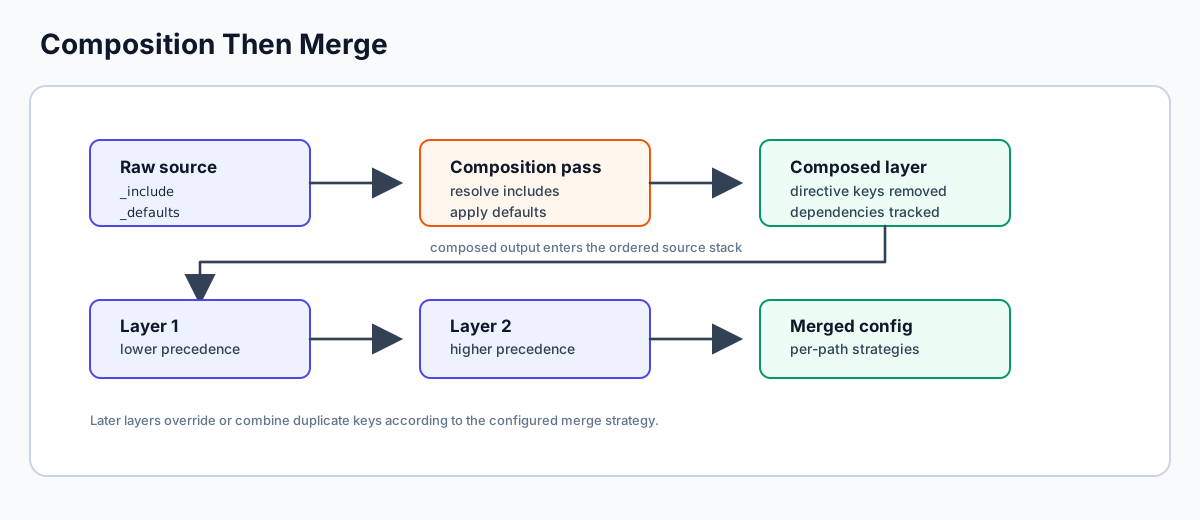
Overview
Composition directives are special keys in your config files:
| Directive | Purpose |
|---|---|
_include |
Import and merge external config files |
_defaults |
Provide inline base values (lowest priority) |
_merge_strategy |
Hint for merge behavior (removed from output) |
All directive keys are removed from the final output -- they never appear in your resolved configuration.
_include Directive
The _include directive loads external config files and deep-merges their contents on top of the current config. This is how you share common configuration across services or split large configs into manageable pieces.
Basic Usage
The resolved config will contain app, logging, and database sections merged together.
Path Resolution
Included file paths are resolved relative to the source file's directory:
project/
config/
config.yaml <-- contains _include: ["shared/db.yaml"]
shared/
db.yaml <-- resolved as config/shared/db.yaml
shared-base.yaml
Absolute paths are also supported:
Single File Include
A single include may be written as a string instead of a list:
Recursive Includes
Included files can themselves contain _include directives. Confii processes them recursively:
Include merge order
Included files are merged on top of the current config. If an included file defines a key that already exists, the included file's value wins. When multiple files are included, they are merged in list order (later files override earlier ones).
_defaults Directive
The _defaults directive provides base values that go underneath the current config. Unlike _include, defaults have the lowest priority -- any value in the current file overrides a default.
Inline String Defaults
Specify simple key-value pairs as "key: value" strings:
_defaults:
- "timeout: 30"
- "retry_count: 3"
- "log_level: info"
timeout: 60 # overrides the default of 30
Result:
timeout: 60 # from config (overrides default)
retry_count: 3 # from defaults
log_level: info # from defaults
Map Defaults
Specify structured defaults as maps:
_defaults:
- cache:
driver: memory
ttl: 300
- server:
host: 0.0.0.0
port: 8080
server:
port: 9090 # overrides the default
Result:
cache:
driver: memory
ttl: 300
server:
host: 0.0.0.0 # from defaults
port: 9090 # from config (overrides default)
Mixing Strings and Maps
Both forms may appear in the same _defaults list:
_merge_strategy Key
The _merge_strategy key is a metadata hint that can be placed in config files. It is always removed from the final output. Its presence is informational -- actual merge behavior is controlled by the WithMergeStrategyMap option in code.
After composition, the output contains only database -- the _merge_strategy key is stripped.
Cycle Detection and Max Depth
Confii tracks visited file paths and prevents circular includes:
Maximum depth is 10
Recursive includes are limited to a depth of 10 levels. If this limit is exceeded, Confii returns an error: "composition max depth (10) exceeded at <path>". This protects against deeply nested or accidentally recursive configurations.
Directive Key Removal
All three directive keys (_include, _defaults, _merge_strategy) are removed from the final output. Your application code never sees them:
Complete Example with shared/ Directory
A realistic project structure using composition:
config/
config.yaml # main config
config.production.yaml # production overrides
shared/
logging.yaml # shared logging config
database.yaml # shared database config
cache.yaml # shared cache config
monitoring.yaml # shared monitoring config
_defaults:
- "environment: development"
- "debug: true"
_include:
- shared/logging.yaml
- shared/database.yaml
- shared/cache.yaml
app:
name: order-service
version: 1.0.0
server:
host: 0.0.0.0
port: 8080
logging:
  level: info
  format: json
  output: stdout
fields:
service: order-service
_include:
  - ../shared/monitoring.yaml  # relative to this file's directory

database:
  driver: postgres
  host: localhost
  port: 5432
  name: orders
  pool_size: 10
  ssl: false
_include:
  - shared/logging.yaml

app:
  debug: false

database:
  host: prod-db.example.com
  pool_size: 50
  ssl: true

cache:
  url: redis://prod-cache.example.com:6379
  ttl: 3600

logging:
  level: warn
package main

import (
    "context"
    "fmt"
    "os"

    "github.com/confiify/confii-go/v2"
    "github.com/confiify/confii-go/v2/loader"
)

func main() {
    ctx := context.Background()

    loaders := []confii.Loader{
        loader.NewYAML("config/config.yaml"),
    }

    if os.Getenv("APP_ENV") == "production" {
        loaders = append(loaders, loader.NewYAML("config/config.production.yaml"))
    }

    cfg, err := confii.NewWithContext[any](ctx,
        confii.WithLoaders(loaders...),
    )
    if err != nil {
        panic(err)
    }

    fmt.Printf("App: %s\n", cfg.GetStringOr("app.name", ""))
    fmt.Printf("DB Host: %s\n", cfg.GetStringOr("database.host", ""))
    fmt.Printf("Cache URL: %s\n", cfg.GetStringOr("cache.url", ""))
    fmt.Printf("Log Level: %s\n", cfg.GetStringOr("logging.level", ""))
    fmt.Printf("Monitoring: %v\n", cfg.GetBoolOr("monitoring.enabled", false))

    // All keys from composed config
    fmt.Printf("All keys: %v\n", cfg.Keys())
}
Composition + Environment Resolution
Composition (_include/_defaults) runs before environment resolution. This means your included files can also contain default/production/etc. sections, and they will be properly resolved after merging. See Environment Resolution for details.
Supported File Formats
Included files are auto-detected by extension:
| Extension | Format |
|---|---|
.yaml, .yml |
YAML |
.json |
JSON |
.toml |
TOML |
| (other) | YAML (default fallback) |