Export & Documentation
Confii can export configuration data to JSON, YAML, and TOML formats, and generate documentation from the current config state.
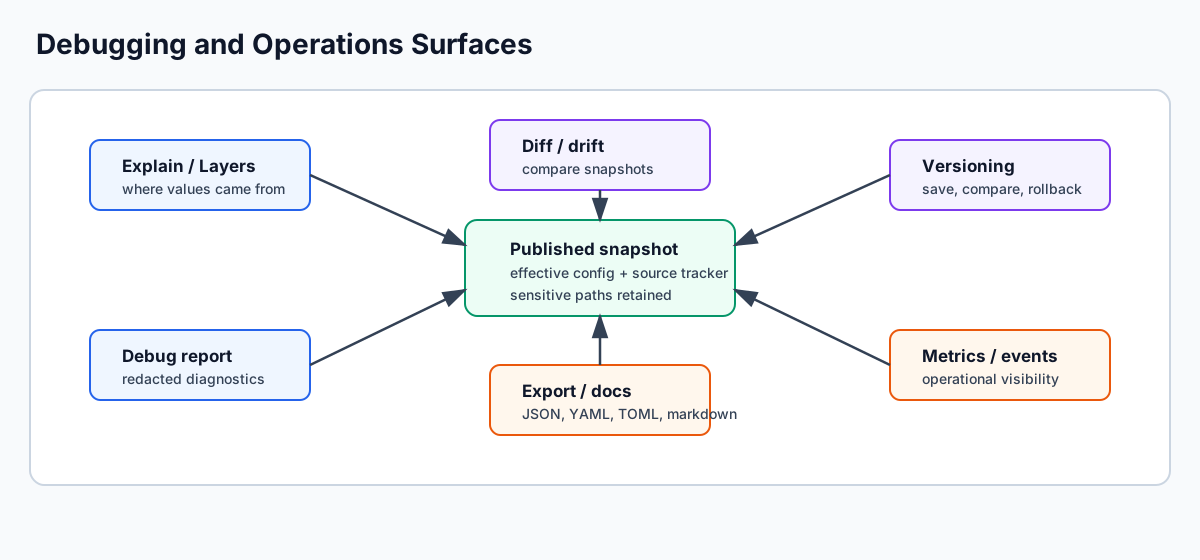
Redacted export
Export and ToDict return resolved secret values verbatim. That is what you
want when writing a rendered configuration into a trusted deployment pipeline,
and what you do not want anywhere else.
safe, err := cfg.RedactedDict()          // map with secrets replaced
data, err := cfg.ExportRedacted("json")  // same, serialized
Both replace every secret-backed value and every path declared through
WithSensitivePaths with [REDACTED: secret-backed value].
Redaction applies to values, not subtrees. A secret at database.password does
not hide database.host: unrelated siblings survive, so a redacted export
remains useful for support and debugging.
ExportRedacted takes no output path. Writing a redacted document to disk is an
ordinary file write, and omitting the parameter keeps the method from reading as
a drop-in replacement for an unredacted export to the same location.
Prefer the redacted forms for anything leaving the process: logs, diagnostic
bundles, error reports, support dumps. Reach for Export only when the
destination is trusted with the secrets themselves.
Export
Export to Bytes
The Export method serializes the effective configuration to the specified format and returns the raw bytes:
Output:
Output:
Export to File
Pass an output path as the second argument to write directly to a file:
data, err := cfg.Export("json", "/path/to/output.json")
if err != nil {
    log.Fatal(err)
}
// data also contains the bytes, and the file is written
// Export as YAML to file
_, err := cfg.Export("yaml", "config-snapshot.yaml")

// Export as TOML to file
_, err := cfg.Export("toml", "config-snapshot.toml")
File permissions
Newly created export files are written with 0600 permissions because the
materialized snapshot may contain resolved secret values.
Custom Export Formats
Implement confii.Exporter to add an application format or replace one of the
built-in JSON, YAML, or TOML serializers:
type dotenvExporter struct{}

func (dotenvExporter) Format() string { return "dotenv" }

func (dotenvExporter) Export(data map[string]any) ([]byte, error) {
    // Serialize the provided snapshot without mutating it.
    return encodeDotenv(data)
}

cfg, err := confii.New[AppConfig](
    confii.WithLoaders(loader.NewYAML("config.yaml")),
    confii.WithExporter(dotenvExporter{}),
)
data, err := cfg.Export("dotenv")
Format must return a non-empty lowercase name without surrounding
whitespace. Registering the same name more than once uses the last exporter;
this intentionally allows an application to replace a built-in serializer.
The fluent builder exposes the same capability through
Builder.WithExporter.
Documentation Generation
GenerateDocs
Generate a reference document from the current configuration state. Each key is listed with its type, current value, and source.
Output:
Output:
Source tracking in docs
The source field in generated docs is populated from Confii's source tracker. Enable WithDebugMode(true) for the most accurate source attribution.
Use Cases
Config Snapshots
Save the current state of your configuration for auditing or debugging:
func snapshotConfig(cfg *confii.Config[any], env string) error {
    filename := fmt.Sprintf("config-snapshot-%s-%s.json",
        env, time.Now().Format("2006-01-02T15-04-05"))

    _, err := cfg.Export("json", filename)
    return err
}
Documentation Generation in CI
Automatically generate config docs as part of your build pipeline:
func generateConfigDocs(cfg *confii.Config[any]) error {
    // Markdown for human-readable docs
    md, err := cfg.GenerateDocs("markdown")
    if err != nil {
        return err
    }
    if err := os.WriteFile("docs/config-reference.md", []byte(md), 0644); err != nil {
        return err
    }

    // JSON for machine-readable docs
    jsonDocs, err := cfg.GenerateDocs("json")
    if err != nil {
        return err
    }
    return os.WriteFile("docs/config-reference.json", []byte(jsonDocs), 0644)
}
Format Conversion
Convert between config formats:
// Load YAML, export as TOML
cfg, _ := confii.NewWithContext[any](ctx,
    confii.WithLoaders(loader.NewYAML("config.yaml")),
    confii.WithEnv("production"),
)

_, err := cfg.Export("toml", "config.toml")
if err != nil {
    log.Fatal(err)
}
CLI Export
Use the CLI tool to export from the command line:
# Export as JSON to stdout
confii export production -l yaml:config.yaml -f json

# Export as YAML to file
confii export production -l yaml:config.yaml -f yaml -o config-export.yaml

# Generate markdown docs
confii docs production -l yaml:config.yaml -f markdown -o CONFIG.md
Full Example
package main

import (
    "context"
    "fmt"
    "log"

    confii "github.com/confiify/confii-go/v2"
    "github.com/confiify/confii-go/v2/loader"
)

func main() {
    ctx := context.Background()

    cfg, err := confii.NewWithContext[any](ctx,
        confii.WithLoaders(
            loader.NewYAML("base.yaml"),
            loader.NewYAML("prod.yaml"),
        ),
        confii.WithEnv("production"),
        confii.WithDebugMode(true),
    )
    if err != nil {
        log.Fatal(err)
    }

    // Export to all formats
    jsonData, _ := cfg.Export("json")
    fmt.Printf("JSON (%d bytes)\n", len(jsonData))

    yamlData, _ := cfg.Export("yaml")
    fmt.Printf("YAML (%d bytes)\n", len(yamlData))

    tomlData, _ := cfg.Export("toml")
    fmt.Printf("TOML (%d bytes)\n", len(tomlData))

    // Export to file
    _, _ = cfg.Export("json", "snapshot.json")
    fmt.Println("Snapshot saved to snapshot.json")

    // Generate docs
    md, _ := cfg.GenerateDocs("markdown")
    fmt.Println("\nConfiguration Reference:")
    fmt.Print(md)
}