Extensibility
Confii is extensible at the same boundaries it uses internally: sources, secrets, hooks, validation, exporters, runtime extension, and provider registration.
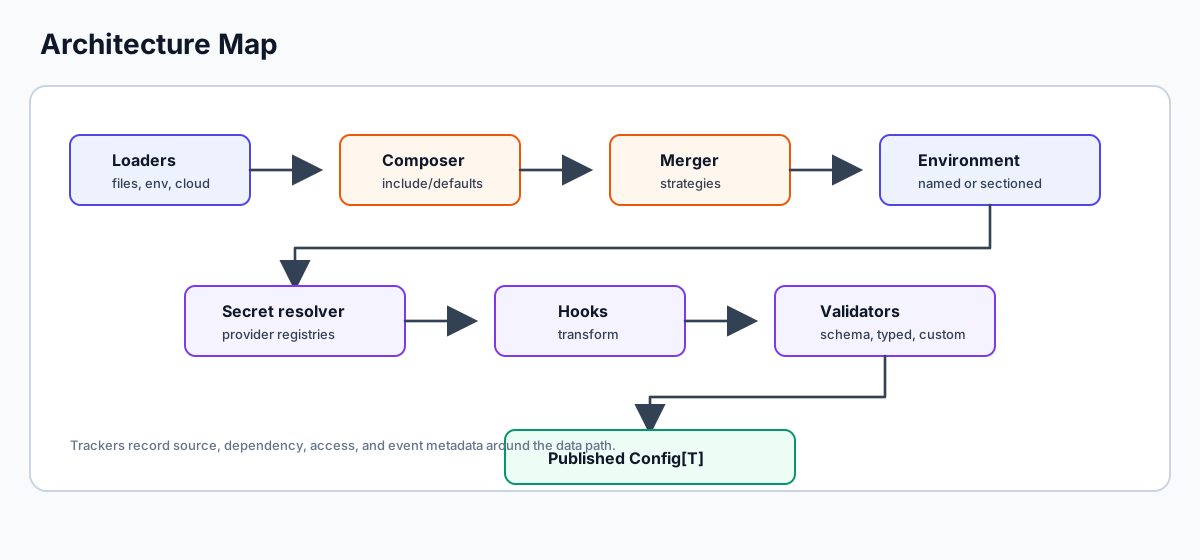
Extension Points
| Extension point | Use it for |
|---|---|
Loader |
Read configuration from a new source such as Consul, Redis, SQL, or an internal API |
SecretStore |
Resolve secrets from a custom backend |
| Hooks | Transform or normalize values before validation and publication |
Validator |
Enforce application-specific invariants |
Exporter |
Add or replace an export format |
Extend |
Add a runtime source transactionally |
| Provider registries | Add declarative .confii.yaml source or secret providers |
Custom Loaders
Implement confii.Loader:
Rules:
- Honor context cancellation for blocking work.
- Return
(nil, nil)only for intentional graceful absence. - Return an error for malformed data, authorization failures, transport failures, or parse failures.
- Keep
Source()stable and non-sensitive; it appears in diagnostics. - Return a map owned by Confii. Do not mutate it after returning.
Example:
type ConsulLoader struct {
    client *consul.Client
    prefix string
}

func (l *ConsulLoader) Source() string {
    return "consul:" + l.prefix
}

func (l *ConsulLoader) Load(ctx context.Context) (map[string]any, error) {
    pairs, _, err := l.client.KV().List(l.prefix, nil)
    if err != nil {
        return nil, err
    }
    if len(pairs) == 0 {
        return nil, nil
    }
    result := map[string]any{}
    for _, pair := range pairs {
        key := strings.TrimPrefix(pair.Key, l.prefix+"/")
        key = strings.ReplaceAll(key, "/", ".")
        if err := configmap.Set(result, key, string(pair.Value)); err != nil {
            return nil, fmt.Errorf("map key %q: %w", pair.Key, err)
        }
    }
    return result, nil
}
Use it as a normal layer:
cfg, err := confii.New[AppConfig](
    confii.WithLoaders(
        loader.NewYAML("config/default.yaml"),
        &ConsulLoader{client: client, prefix: "myapp"},
    ),
)
Custom Secret Stores
Implement confii.SecretStore:
type SecretStore interface {
    GetSecret(ctx context.Context, key string, opts ...SecretOption) (any, error)
    SetSecret(ctx context.Context, key string, value any, opts ...SecretOption) error
    DeleteSecret(ctx context.Context, key string, opts ...SecretOption) error
    ListSecrets(ctx context.Context, prefix string) ([]string, error)
}
Rules:
- Honor context cancellation.
- Return
ErrSecretNotFoundonly for genuine absence. - Wrap authentication, authorization, transport, and backend failures with
ErrSecretAccessorErrSecretStore. - Do not log or expose secret values through errors.
- Treat
SecretOptionvalues such as version and field explicitly. If the backend cannot support one, return a clear error instead of silently ignoring it. - Make the store safe for the concurrency it advertises.
Example skeleton:
type RedisSecretStore struct {
    client *redis.Client
}

func (s *RedisSecretStore) GetSecret(ctx context.Context, key string, opts ...confii.SecretOption) (any, error) {
    options := confii.ResolveSecretOptions(opts...)
    if options.Version != "" {
        return nil, fmt.Errorf("%w: Redis store does not support versions", confii.ErrSecretStore)
    }
    value, err := s.client.Get(ctx, "secrets:"+key).Result()
    if errors.Is(err, redis.Nil) {
        return nil, fmt.Errorf("%w: %s", confii.ErrSecretNotFound, key)
    }
    if err != nil {
        return nil, fmt.Errorf("%w: read Redis secret %s: %v", confii.ErrSecretStore, key, err)
    }
    return value, nil
}

func (s *RedisSecretStore) SetSecret(ctx context.Context, key string, value any, opts ...confii.SecretOption) error {
    return s.client.Set(ctx, "secrets:"+key, value, 0).Err()
}

func (s *RedisSecretStore) DeleteSecret(ctx context.Context, key string, opts ...confii.SecretOption) error {
    return s.client.Del(ctx, "secrets:"+key).Err()
}

func (s *RedisSecretStore) ListSecrets(ctx context.Context, prefix string) ([]string, error) {
    return nil, fmt.Errorf("%w: listing is not implemented", confii.ErrSecretStore)
}
Wire it through the resolver:
resolver := secret.NewResolver(&RedisSecretStore{client: rdb}, secret.WithCache(true))
cfg, err := confii.New[AppConfig](confii.WithSecretResolver(resolver))
Hooks
Use hooks for transformations that should be visible in every read surface:
cfg, err := confii.New[AppConfig](
    confii.WithKeyHook("app.name", func(ctx context.Context, key string, value any) (any, error) {
        s, ok := value.(string)
        if !ok {
            return nil, fmt.Errorf("%s must be string", key)
        }
        return strings.TrimSpace(s), nil
    }),
)
Hooks run before validation and publication. Returning an error rejects the candidate.
Custom Value Resolvers
Use a value resolver when you want configuration authors to write a compact
${scheme:...} expression instead of a general-purpose hook. Resolvers receive
the parsed request and may return any Go value:
cfg, err := confii.New[AppConfig](
    confii.WithValueResolver("upper", func(ctx context.Context, req hook.ResolverRequest) (any, error) {
        if err := ctx.Err(); err != nil {
            return nil, err
        }
        return strings.ToUpper(req.Target), nil
    }),
)
Config:
ResolverRequest contains:
| Field | Meaning |
|---|---|
Scheme |
Lower-level scheme name, such as upper |
Target |
Text between scheme: and optional # |
Fragment |
Text after #, useful for field selection |
Key |
Dot-separated config key being materialized |
Rules:
- Honor context cancellation before blocking I/O.
- Return errors for missing, unauthorized, malformed, or unsafe values.
- Do not log sensitive resolved values.
- Keep resolver schemes stable and lowercase-friendly.
- Treat resolvers as startup/materialization work, not per-read work.
Custom resolvers run in the same value-reference phase as built-ins. If a custom scheme matches a built-in scheme, the custom resolver overrides the built-in for that configuration.
Custom Validators
Use validators for domain rules:
type productionPolicy struct{}

func (productionPolicy) Validate(data map[string]any) error {
    env, _ := data["environment"].(string)
    debug, _ := data["debug"].(bool)
    if env == "production" && debug {
        return errors.New("debug must be disabled in production")
    }
    return nil
}

cfg, err := confii.New[AppConfig](confii.WithValidator(productionPolicy{}))
Validators receive an independent copy. They must not be used as transformers.
Custom Exporters
Implement Exporter when an application needs a non-built-in export format or
wants to replace the default JSON/YAML/TOML behavior.
Register before construction:
Exporter format names must be stable lowercase identifiers. Exporters receive the effective snapshot; they must handle secret material carefully.
Runtime Source Extension
Add a source after initialization:
The new source is merged at the highest precedence position and included in future reloads. Publication is transactional.
Declarative Provider Registries
Provider packages can register declarative source or secret implementations so
applications can use them from .confii.yaml.
Rules:
- Register once, normally from package
init. - Use a stable canonical type name.
- Validate provider-specific fields in the factory.
- Reject unsafe paths, traversal, ambiguous credentials, and secret-bearing source identifiers.
- Keep optional provider dependencies outside the core module when possible.
See Architecture.
Extension Testing Checklist
- Cancellation: blocking calls return when
ctxis canceled. - Error categories: expected errors wrap Confii sentinel errors.
- Redaction:
Source()and errors do not contain secrets. - Concurrency: shared clients and caches are safe.
- Graceful absence: missing optional source returns
(nil, nil). - Publication: failed load/validation does not mutate the previous snapshot.
- Introspection:
Explain,Layers, and debug reports show useful source names. - Path safety: external keys cannot escape intended prefixes.