Context, cancellation, and operation lifecycles
Confii treats context.Context as the control plane for work, not as stored
configuration data. Contexts bound loader calls, cloud authentication, secret
reads, composition, hooks, validation, reloads, extensions, exports, diffs,
and runtime materialization.
Construction
Use New for a bounded, self-contained startup:
When the caller supplies no deadline, Confii applies startup.timeout
(60s by default). Use NewWithContext to inherit cancellation, trace values, or
an existing deadline:
ctx, cancel := context.WithTimeout(context.Background(), 15*time.Second)
defer cancel()

cfg, err := confii.NewWithContext[AppConfig](ctx)
An existing deadline is never extended or replaced. Cancellation is terminal:
on_error: warn and on_error: ignore cannot convert it into success.
Runtime operations
Prefer context-aware APIs whenever an operation may invoke hooks, providers, or I/O:
err = cfg.ReloadWithContext(ctx)
err = cfg.ExtendWithContext(ctx, loader)
err = cfg.RefreshSecretsWithContext(ctx)
err = cfg.SetWithContext(ctx, "feature.enabled", true)
restore, err := cfg.OverrideWithContext(ctx, overrides)
model, err := cfg.TypedWithContext(ctx)
changes, err := cfg.DiffWithContext(ctx, other)
Convenience methods such as Reload, Extend, RefreshSecrets, Set,
Override, Typed, and Diff use an
implicit context bounded by runtime.timeout (30s by default). Configure it
with WithOperationTimeout; explicit *WithContext APIs retain their caller
deadline. The suffix is deliberate: SetWithContext means “perform Set using
this operation context,” never “store or replace a context on Config.”
The naming contract is uniform across the paired public API:
| Bounded convenience operation | Caller-controlled operation |
|---|---|
confii.New(...) |
confii.NewWithContext(ctx, ...) |
builder.Build() |
builder.BuildWithContext(ctx) |
cfg.Get(key) |
cfg.GetWithContext(ctx, key) |
cfg.ToDict() |
cfg.ToDictWithContext(ctx) |
cfg.Typed() |
cfg.TypedWithContext(ctx) |
cfg.TypedCopy() |
cfg.TypedCopyWithContext(ctx) |
cfg.Set(key, value) |
cfg.SetWithContext(ctx, key, value) |
cfg.Override(values) |
cfg.OverrideWithContext(ctx, values) |
cfg.Reload(...) |
cfg.ReloadWithContext(ctx, ...) |
cfg.Extend(loader) |
cfg.ExtendWithContext(ctx, loader) |
cfg.RefreshSecrets() |
cfg.RefreshSecretsWithContext(ctx) |
cfg.Export(format) |
cfg.ExportWithContext(ctx, format) |
cfg.Diff(other) |
cfg.DiffWithContext(ctx, other) |
cfg.DetectDrift(intended) |
cfg.DetectDriftWithContext(ctx, intended) |
cfg.SaveVersion(metadata) |
cfg.SaveVersionWithContext(ctx, metadata) |
cfg.RollbackToVersion(id) |
cfg.RollbackToVersionWithContext(ctx, id) |
composer.Compose(...) |
composer.ComposeWithContext(ctx, ...) |
composer.ComposeWithDependencies(...) |
composer.ComposeWithDependenciesWithContext(ctx, ...) |
watch.New(...) |
watch.NewWithContext(ctx, ...) |
cloud.NewHashiCorpVault(...) |
cloud.NewHashiCorpVaultWithContext(ctx, ...) |
cloud.NewOpenBao(...) |
cloud.NewOpenBaoWithContext(ctx, ...) |
Registration and dispatch follow the same vocabulary:
OnChangeWithContext, OnWithContext, OffWithContext, and
EmitWithContext.
Lower-level contracts that always perform caller-owned work continue to require
a context: loader Load, hook Process, secret-store operations, and provider
authentication.
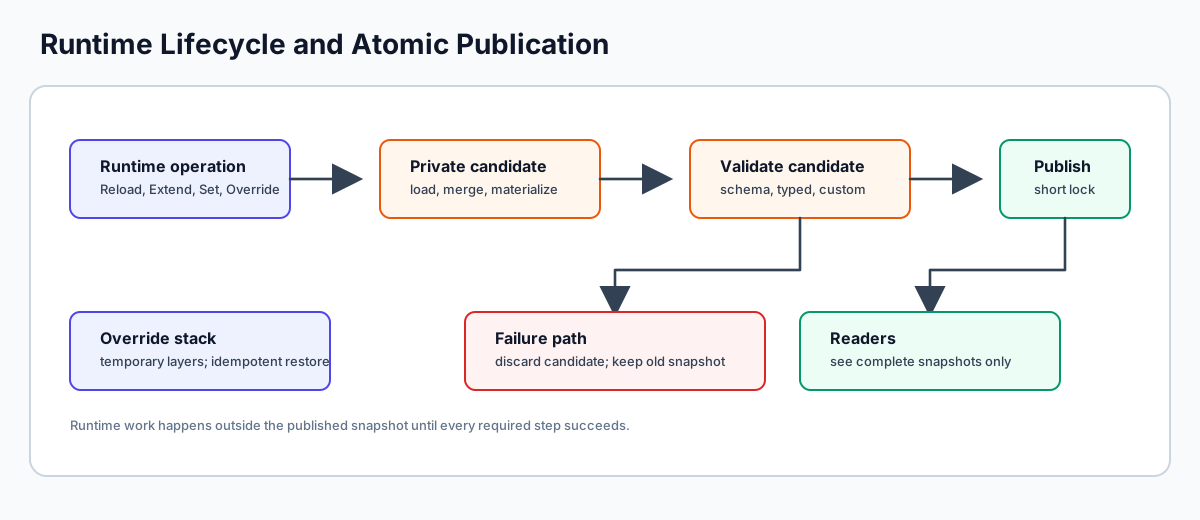
Reload and Extend build private candidates while performing I/O. Concurrent readers continue to receive the last complete snapshot; publication uses a short lock after validation. If another mutation wins the commit race, Confii rebuilds the candidate rather than overwriting that mutation.
Observability
Use context-aware callbacks and event listeners to preserve trace and request correlation:
cfg.OnChangeWithContext(func(ctx context.Context, key string, oldValue, newValue any) {
    span := trace.SpanFromContext(ctx)
    span.AddEvent("configuration changed")
})

cfg.EnableEvents().OnWithContext("reload", func(ctx context.Context, args ...any) {
    logger.InfoContext(ctx, "configuration reloaded")
})
Context-free OnChange and On listeners remain available.
Typed and TypedWithContext share the same cached typed-view semantics.
Use TypedCopy or TypedCopyWithContext when ownership isolation is required;
the presence of a context does not implicitly request a copy.
Resource ownership
Call Close when the Config is no longer needed:
cfg, err := confii.New[AppConfig](confii.WithDynamicReloading(true))
if err != nil { /* handle */ }
defer cfg.Close()
Close is idempotent. It stops watchers and closes owned loaders, managed
resolvers, and declaratively created providers that implement Close() error,
including a provider first initialized lazily by a runtime mutation.
The final snapshot remains readable, while mutations return
confii.ErrConfigClosed.
Secret concurrency
Startup and refresh resolve independent top-level configuration branches in parallel. Bound provider pressure with:
or confii.WithSecretResolutionConcurrency(4). Duplicate references to the
same provider/key/version are still coalesced within one materialization pass.