Hook System
Confii v2 treats hooks as configuration transformations. Hooks are registered before construction, frozen into the materialization plan, and run before a snapshot is published:
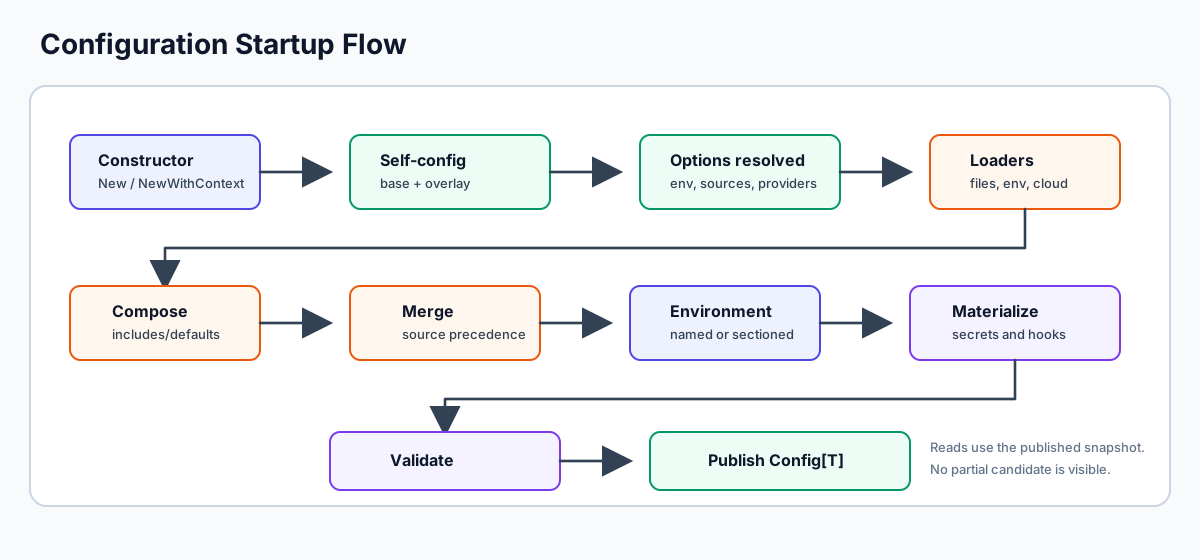
load → compose → select environment → transform hooks → resolve secrets
     → validate → publish immutable snapshot
Get, Typed, ToDict, and Export all read the same materialized snapshot.
They do not rerun hooks or contact a secret provider. Set, Override,
Extend, Reload, and RefreshSecrets build a candidate through the same
pipeline and publish it only when every transformation and validation succeeds.
This is especially important for typed configuration: a field expression such
as appConfig.Server.Host observes the value produced for server.host during
materialization. No generated getter or repeated cfg.Get call is required.
Registering hooks
Four construction options correspond to the four transformation selectors:
cfg, err := confii.New[AppConfig](
    confii.WithLoaders(loader.NewYAML("config.yaml")),
    confii.WithKeyHook("app.name", func(ctx context.Context, key string, value any) (any, error) {
        return strings.ToUpper(value.(string)), nil
    }),
    confii.WithValueHook("PLACEHOLDER", func(ctx context.Context, key string, value any) (any, error) {
        return "resolved", nil
    }),
    confii.WithConditionHook(
        func(ctx context.Context, key string, value any) (bool, error) {
            return strings.HasSuffix(key, ".host"), nil
        },
        func(ctx context.Context, key string, value any) (any, error) {
            return strings.TrimSpace(value.(string)), nil
        },
    ),
    confii.WithGlobalHook(func(ctx context.Context, key string, value any) (any, error) {
        return value, nil
    }),
)
The builder exposes the matching WithKeyHook, WithValueHook,
WithConditionHook, and WithGlobalHook methods.
Hook order for every leaf is:
- exact key hooks;
- matching value hooks;
- condition hooks whose predicates return
true; - global hooks.
Registration order is preserved within each category. Every callback receives the full dotted key path and the startup or mutation context. Returning an error aborts the candidate transaction; no partial transformed state becomes visible.
Secret resolvers
Imperative secret resolution is also construction-time:
resolver := secret.NewResolver(store, secret.WithCache(true))

cfg, err := confii.New[AppConfig](
    confii.WithLoaders(loader.NewYAML("config.yaml")),
    confii.WithSecretResolver(resolver),
)
WithSecretResolver lets RefreshSecrets clear the resolver cache before
building a fresh candidate. WithSecretHook(resolver.Hook()) is available when
cache management is owned elsewhere.
Missing secrets and provider failures always return errors in v2. Optionality belongs in an explicit schema or reference model; unresolved placeholders are never silently published.
Value Resolvers
Value resolvers are specialized global hooks for ${scheme:...} expressions.
They run after environment expansion and before type casting, application hooks,
and secret resolution. That order lets a referenced file or self field contain
${secret:...} and still have the secret resolved by the normal secret phase.
Built-in resolver families are opt-in:
cfg, err := confii.New[AppConfig](
    confii.WithWorkingDir("/srv/app"),
    confii.WithStructuredResolver(true), // ${json:path#field}, ${yaml:path#field}, self refs
    confii.WithFileResolver(true),       // ${file:path}
    confii.WithURLResolver(false),       // keep network I/O off unless needed
    confii.WithCommandResolver(false),   // keep shell execution off unless needed
)
Custom resolvers use WithValueResolver:
cfg, err := confii.New[AppConfig](
    confii.WithValueResolver("upper", func(ctx context.Context, req hook.ResolverRequest) (any, error) {
        return strings.ToUpper(req.Target), nil
    }),
)
Configuration:
If the reference is the complete scalar, the resolver's Go value is preserved. If it is embedded inside a larger string, Confii stringifies the returned value. Unknown schemes are left unchanged so another hook or application layer may handle them.
Runtime read behavior
Normal reads are deliberately side-effect free. If an application needs request-specific authorization, masking, or telemetry, perform that in an application read layer rather than a transformation hook. This keeps the configuration snapshot consistent across scalar, map, typed, export, and introspection APIs.
Standalone processor
The hook package still exposes hook.NewProcessor() for applications that
need the transformation engine independently of Config. A Config's internal
processor is not mutable after construction.